
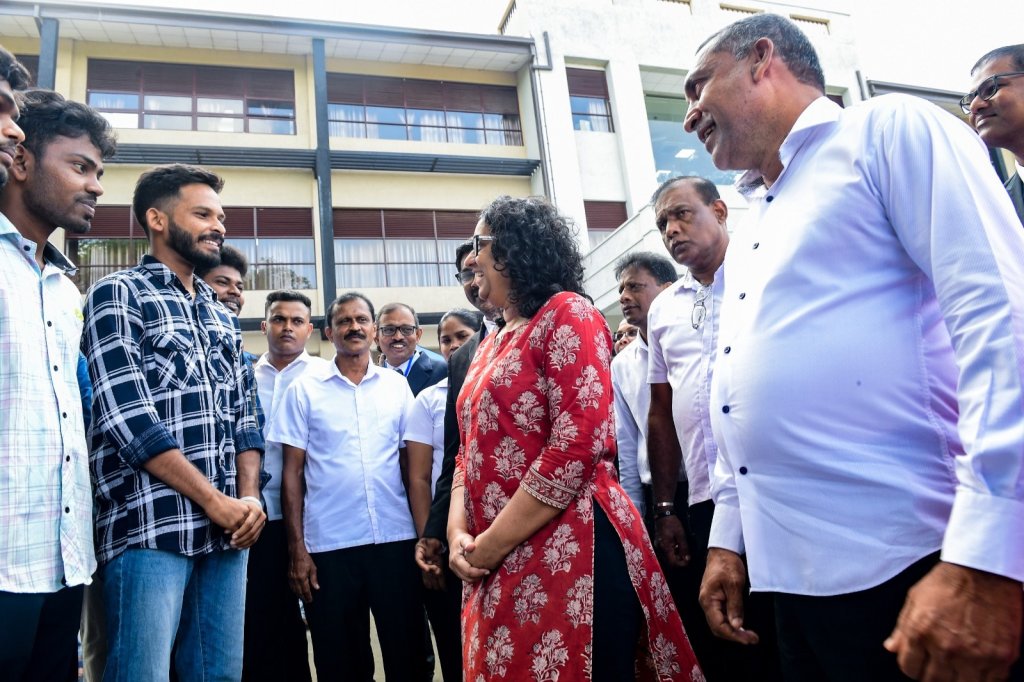
Colombo, August 2, 2025 — Prime Minister and Education Minister Dr. Harini Amarasuriya has laid out a comprehensive vision for reforming Sri Lanka’s public education system, calling it a critical national priority tied directly to the country’s future economic and social development.
Speaking during a series of regional stakeholder consultations in Galle and Jaffna, Dr. Amarasuriya said the reforms, which are to be phased in starting 2026, would target long-standing structural issues, particularly overcrowded classrooms, outdated teaching methods, lack of practical skills education, and declining trust in public schools.
“We are still working within an education system designed for a very different world,” she told a gathering of teachers and administrators. “Our children deserve classrooms that are functional, relevant, and future-ready.”
Five Pillars of Reform
The government’s education reform strategy rests on five core pillars:
Modernising Curricula – Updating syllabi to reflect real-world skills, scientific literacy, and social relevance. Strengthening Human Resources – Re-training teachers and principals; revamping outdated teacher training college content. Infrastructure Development – Renovating dilapidated schools and ensuring safe, well-equipped learning environments. Public Engagement – Rebuilding trust in the system through transparency and community involvement. Assessment Reform – Moving away from rote memorisation and high-stakes exams to more holistic, skills-based evaluation.
Overcrowding and Tuition Culture
One of the most urgent targets, the Prime Minister said, is reducing class sizes across the country. Many government schools currently operate with as many as 50 students in a classroom.
“You cannot deliver quality education when children are crammed into spaces that don’t support learning,” she said. “Our aim is to bring that number down to 25 or 30 per class.”
Dr. Amarasuriya also directly addressed the rise of tuition dependency, especially in urban centres.
“When school quality declines, tuition steps in to fill the gap—but this is unsustainable and deeply unfair,” she said. “The reforms are about making schools strong enough that extra classes become a choice, not a necessity.”
Elevating Vocational Training
The reforms also include a rebranding of technical and vocational education through the Shrama Meheyuma initiative. The programme, already piloted in several provinces, aims to make skill-based education part of the mainstream school system—rather than a fallback option.
“We must erase the stigma around vocational education,” the Prime Minister said. “We want young people to pursue paths that match their talent and economic opportunity—not outdated stereotypes.”
Broad Political Will
While some teacher unions and provincial education directors have voiced concern about the speed and scope of the reforms, the Prime Minister stressed that wide consultations are ongoing and that implementation will be done gradually but decisively.
“Education is not just about textbooks and buildings,” she said. “It’s about reshaping a society that can think critically, work ethically, and solve the problems of tomorrow.”
The first wave of pilot schools under the reformed curriculum is expected to begin operations by mid-2026. Full national rollout is targeted by 2028, pending legislative and administrative approval.
As of this week, the Ministry of Education is finalising guidelines for stakeholder input, while an island-wide teacher re-training initiative is scheduled to begin later this month.
Key Highlights:
Class size reform to reduce average to 25–30 students Curriculum overhaul to include digital and practical skill modules Shrama Meheyuma to elevate technical education within schools Physical upgrades planned for over 1,200 schools by end of 2026 New teacher training framework under development
Sri Lanka’s education overhaul is being framed as one of the most ambitious public sector transformations in recent memory. Whether the reforms can be delivered equitably across provinces remains the key challenge—but the political will appears firmly in place.


Leave a comment