
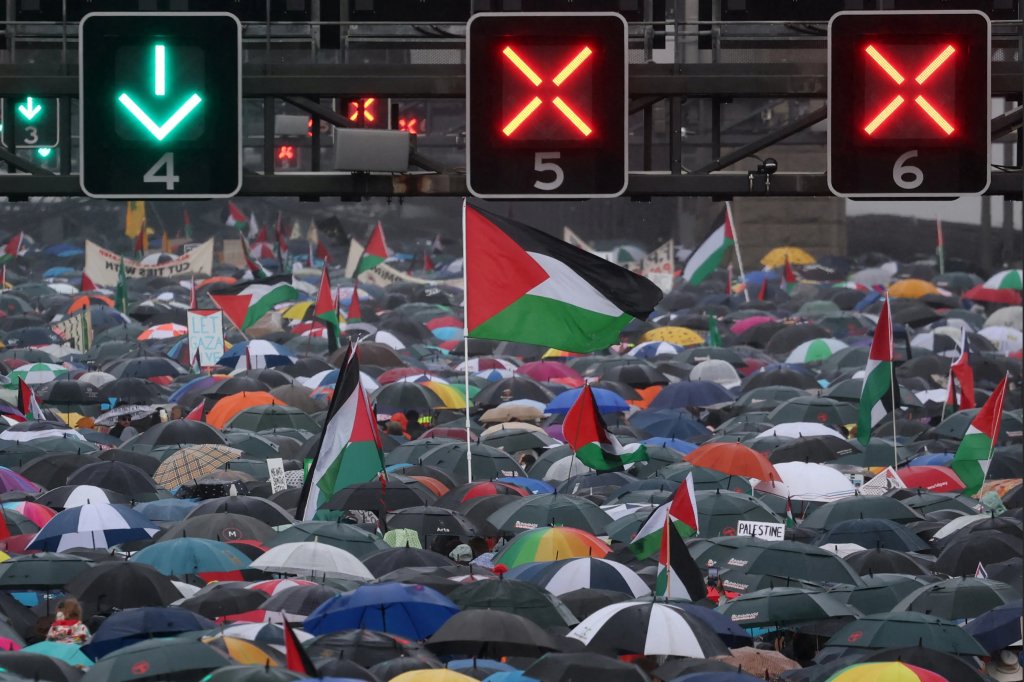
Sydney, August 3, 2025 — In one of the most visible acts of civil protest in Australia’s recent history, tens of thousands of demonstrators marched across the Sydney Harbour Bridge on Sunday afternoon, waving Palestinian flags and calling for an end to the ongoing humanitarian crisis in Gaza.
The march, organized by the Palestine Action Group Sydney, was initially threatened with prohibition by New South Wales Police, who cited safety concerns due to its planned route across one of the city’s busiest transport arteries. However, in a late-night ruling on Saturday, the NSW Supreme Court granted legal authorization for the demonstration to proceed, affirming the public’s right to peaceful assembly.
Justice Belinda Rigg, who presided over the case, acknowledged the disruption the protest would cause but ruled that the right to protest “should not be extinguished purely because it causes inconvenience,” especially in the context of what she described as a “serious and urgent humanitarian issue.”
The protest began around midday, with organizers estimating attendance between 25,000 and 50,000, despite steady rainfall. Some reports suggested the number may have reached up to 100,000. The crowd was made up of families, students, activists, union groups, and several public figures, all united under the banner of justice for Palestinians.
Among the participants were federal MP Ed Husic, Greens Senator Mehreen Faruqi, and prominent cultural voices like actor Meyne Wyatt. Many carried signs calling for an end to Australia’s arms exports to Israel and demanded stronger diplomatic pressure in response to the siege of Gaza.
The Harbour Bridge was officially closed to vehicular traffic shortly after 11:30 a.m., with heavy police presence ensuring safety and crowd control. Officers on horseback and riot squads were deployed, but the event remained peaceful throughout. Authorities sent mobile alerts by mid-afternoon advising protesters to return via the bridge in staggered groups to avoid crowd congestion at public transport stations.
While the protest caused widespread traffic delays and rerouted public transport services across the city, no major incidents were reported.
Critics, including the Jewish Board of Deputies, condemned the court’s decision, arguing the march politicized a national landmark and disrupted essential services. Supporters, however, hailed the day as a triumph of democratic rights and public solidarity in the face of global injustice.
As evening fell and the bridge reopened, cleanup crews worked to restore traffic flow. But the symbolic weight of Sunday’s protest will likely resonate for weeks to come—both as a powerful statement of support for Palestine and as a legal milestone for civil protest in Australia.





Leave a comment