
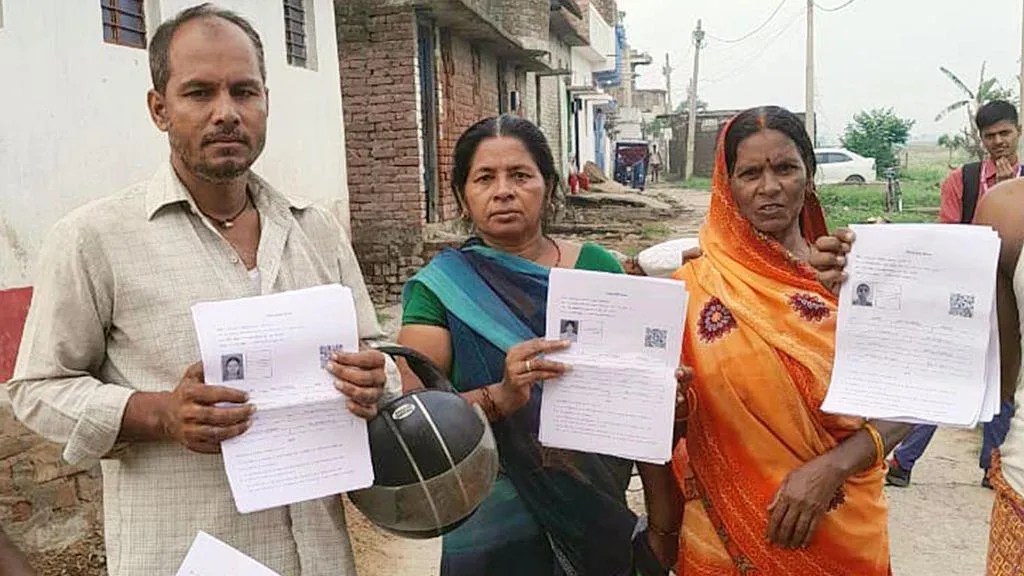
Patna, India — The Election Commission of India recently released updated draft electoral rolls for Bihar, where crucial assembly elections are slated for November. The revision followed a month-long exercise known as the Special Intensive Revision (SIR), carried out from June 25 to July 26 to verify details of the state’s approximately 78.9 million registered voters.
The Commission reported the new draft contains 72.4 million names, a decrease of 6.5 million from the previous list. It attributes the reduction to the removal of deceased individuals, duplicate entries, and those who have migrated out of Bihar. Officials claim a door-to-door verification was conducted for all voters, marking the first revision since 2003.
Despite these assurances, the SIR exercise has drawn sharp criticism from opposition parties, electoral watchdogs, and many local residents who report errors and omissions in the new draft. Voters in Bihar’s capital Patna and surrounding villages have flagged issues such as incorrect photographs, duplicate names, and the inclusion of deceased individuals.
In Danara village, home to many Mahadalits — among the state’s most disadvantaged communities — residents expressed uncertainty about the revision’s impact. “Losing my vote would push us further into poverty,” said Rekha Devi, a local farm worker.
In neighboring Kharika, farmer and retired teacher Tarkeshwar Singh shared documents highlighting multiple inaccuracies. “There are wrong photos, repeated names, and even dead people still on the list,” he said. “It seems no proper checks were done.”
Opposition parties, led by the Rashtriya Janata Dal (RJD), accuse the Commission of rushing the process and deliberately disenfranchising voters, particularly Muslims concentrated in four border districts. They claim this could benefit the ruling Bharatiya Janata Party (BJP) ahead of the polls. The Commission and the BJP reject these allegations, emphasizing the need to remove non-citizens and maintain a clean voters’ list.
Bhim Singh, a BJP Member of Parliament from Bihar, said, “The SIR has nothing to do with religion. We need to weed out Rohingya and Bangladeshi migrants who have settled illegally.” Neeraj Kumar Singh, spokesperson for the Janata Dal (United), BJP’s alliance partner, called the process “necessary to correct multiple entries.”
The controversy has spilled into India’s Parliament, causing repeated disruptions as opposition lawmakers demand a debate on the revision. The Supreme Court is also reviewing the matter after the Association for Democratic Reforms (ADR) challenged the timing and conduct of the SIR, warning it could disenfranchise millions of genuine voters, especially poor migrant workers lacking documentation.
The Court has indicated it may halt the process if petitioners can present 15 genuine voters excluded from the draft rolls — a difficult task given the Commission has not publicly disclosed the names removed.
Jagdeep Chhokar of ADR highlighted the burden now on voters to prove their citizenship and eligibility amid a tight deadline, calling the exercise “massively flawed.”
As Bihar approaches one of its most critical elections in recent years, the electoral roll revision underscores the challenges of maintaining democratic participation in a populous, diverse state grappling with migration, administrative hurdles, and political polarization.

Leave a comment