
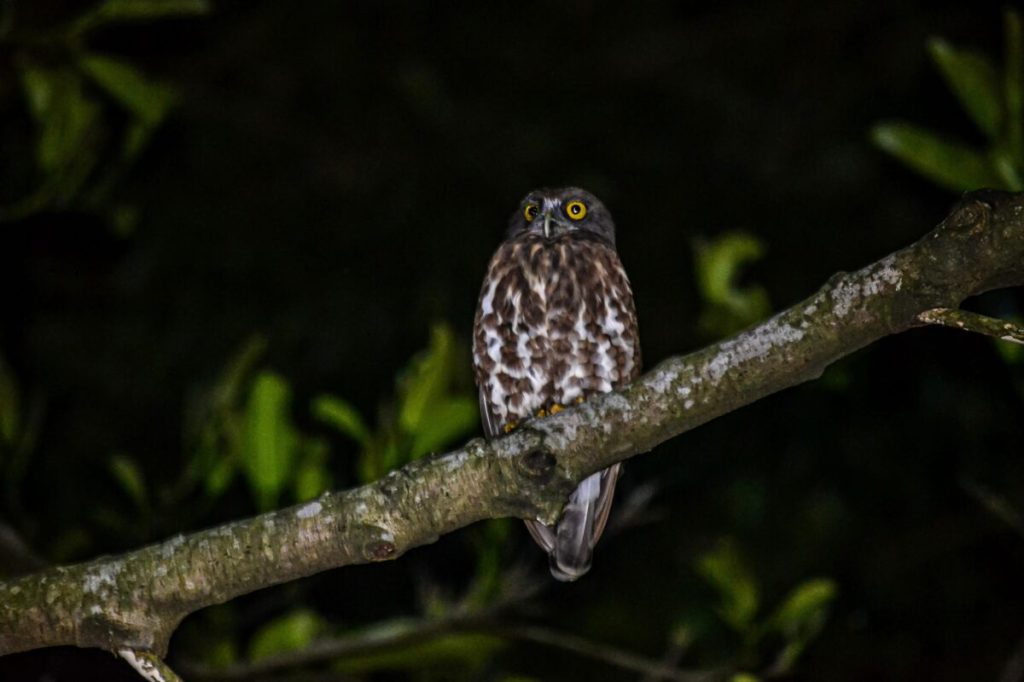
COLOMBO, Sri Lanka — As darkness falls over Sri Lanka’s bustling commercial capital, a dedicated group of volunteers and researchers quietly venture into hidden pockets of green space to seek out one of the city’s most elusive residents: owls. Marking International Owl Day, observed annually on August 4, the nocturnal survey conducted by the Field Ornithology Group of Sri Lanka (FOGSL) reveals a surprising resilience among several owl species amid Colombo’s urban sprawl.
From the diminutive Indian scops owl (Otus bakkamoena) and the brown hawk-owl (Ninox scutulata), to the elusive barn owl (Tyto alba), these birds continue to thrive in city parks, old cemeteries, and university grounds despite habitat loss and human disturbance. The barn owl, in particular, stands out as a valuable natural ally against rodents in urban settings, yet it struggles against deep-rooted superstitions that often lead to its persecution.
On a recent survey night, teams dispersed along assigned routes across Colombo, including areas such as Borella Kanatte Cemetery and Viharamahadevi Park. Armed with torches and keen ears, they recorded over 50 individual owls, a testament to the birds’ adaptability and the city’s green refuges. More than 250 participants, including university students and bird enthusiasts, joined the effort, blending scientific research with community involvement.
Despite their ecological importance, owls in Sri Lanka remain widely misunderstood. Cultural beliefs often cast them as harbingers of misfortune. The haunting call of the forest eagle-owl (Ketupa nipalensis), locally known as the “ulama” or “devil bird,” is embedded in folklore as a portent of death or tragedy, leading many to fear and drive away these nocturnal creatures.
“People hear the owl’s call and immediately think of bad luck,” says Nihal Dayawansa, president of FOGSL and zoology professor at the University of Colombo. “This fear results in owls being chased from their nesting sites, despite their role in keeping rodent populations in check.”
Historically, Sri Lankan farmers practiced sustainable methods that welcomed owls. Hollow coconut trunks were placed in fields to encourage barn owls to nest and hunt rodents naturally—an effective pest control long before modern pesticides. Conservationists today hope to revive such nature-based solutions in urban agriculture to promote coexistence and reduce chemical use.
However, urban owls face growing threats beyond superstition: rapid urbanization, habitat fragmentation, noise and light pollution, and road accidents all imperil their survival. The discovery of the Serendib scops owl (Otus thilohoffmanni), Sri Lanka’s only new owl species described in recent decades, highlights the importance of targeted research and conservation efforts.
“The Serendib scops owl’s discovery reminds us of how much remains to be understood about our native wildlife,” notes Deepal Warakagoda, president of the Ceylon Bird Club. “Protecting urban owls is part of a larger fight to preserve biodiversity in a changing landscape.”
For Colombo’s nocturnal explorers, the annual owl survey is more than data collection—it is a step toward breaking cultural myths and fostering appreciation for these mysterious birds. As the city sleeps, the gentle hoots echo a call for coexistence and conservation.
In Sri Lanka’s ever-expanding urban environment, the silent flight of owls remains a poignant reminder: nature still finds refuge where respect and understanding grow.





Leave a comment