
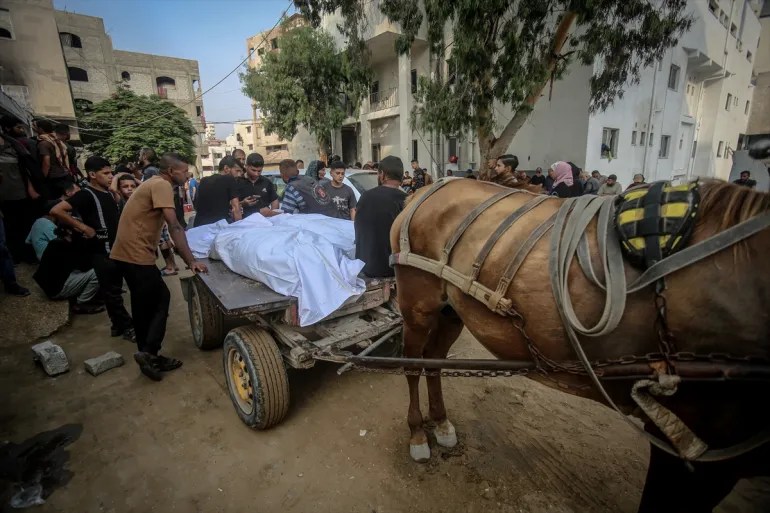
GAZA CITY, Gaza —
The war in Gaza has entered its most lethal stage yet. On Tuesday, Israeli strikes killed at least 73 Palestinians across the enclave. Two more deaths — a six-year-old boy and a 30-year-old man — were attributed to malnutrition, bringing the confirmed toll from starvation to 227.
For United Nations officials, the data paints a bleak picture: a siege that has collapsed Gaza’s food systems, decimated its health infrastructure, and displaced nearly 2 million people.
“This is the textbook definition of collective punishment,” said a senior UN humanitarian adviser. “The destruction is total — not just of buildings, but of the conditions needed for life itself.”
A War on Truth
The violence is not confined to the battlefield. In recent days, UN special rapporteurs Irene Khan and Francesca Albanese have condemned what they describe as Israel’s “deliberate targeting” of journalists, including Al Jazeera’s Anas al-Sharif. More than 200 reporters have been killed in Gaza since the war began — the highest number recorded in any modern conflict.
The killings have intensified global debate over the role of media in shaping perceptions of war. Outside The New York Times headquarters in New York City, hundreds of protesters accused mainstream outlets of “running cover” for Israel’s military campaign.
Nas Issa, an organizer with the Palestinian Youth Movement, said the protest was about accountability:
“When the press refuses to name atrocities for what they are, they become part of the machinery that enables them.”
Diplomacy in a Stalemate
Even as the humanitarian crisis deepens, diplomatic channels remain gridlocked. A Hamas delegation in Cairo has entered another round of talks, mediated by Egypt, Qatar, and the United States, to secure a temporary ceasefire.
The proposed agreement reportedly involves a phased release of hostages in exchange for Palestinian detainees and a guarantee of unrestricted humanitarian aid. But Prime Minister Benjamin Netanyahu’s government insists on the release of all hostages as a precondition, a stance that has repeatedly stalled negotiations.
Meanwhile, Australia, Canada, Japan, the United Kingdom, and 23 European allies issued a joint statement urging Israel to ease restrictions on aid. Notably, Germany and Hungary refused to sign, exposing fault lines within the Western alliance.
The Numbers Behind the Siege
- Total deaths since Oct 2023: 43,200+ (Gaza Health Ministry)
- Starvation-related deaths: 227 confirmed
- Displaced: 1.9 million (85% of Gaza’s population)
- Journalists killed: 200+
- Operational hospitals: 9 of 36
- Average daily aid trucks: Fewer than 20 (pre-war: 500)
Strategic Consequences
The war’s effects extend far beyond Gaza. In Arab capitals, the images of devastation have reignited public anger toward governments that maintain security ties with Israel. In Western capitals, political divisions over Israel’s conduct are hardening, with some governments under pressure to reconsider arms exports.
For Israel, the campaign in Gaza is increasingly seen not only as a fight against Hamas, but as a struggle over its legitimacy on the world stage. For Palestinians, the war has become a fight for survival — and for the right to narrate their own history.
A Precarious Horizon
In Gaza City, where airstrikes have reduced entire districts to rubble, residents speak of the war in terms of exhaustion rather than endurance.
Majed al-Hosary, who lives in the battered Zeitun neighborhood, described a night of relentless shelling:
“The ground shakes, the sky burns, and there is nowhere to run. Our children ask why there is no bread. We have no answer.”
Whether through street protests in New York, diplomatic maneuvering in Cairo, or the quiet work of humanitarian corridors, the battle over Gaza’s future — and over the truth of what is happening there — is far from over. But with each passing day, the cost of inaction grows.


Leave a comment