
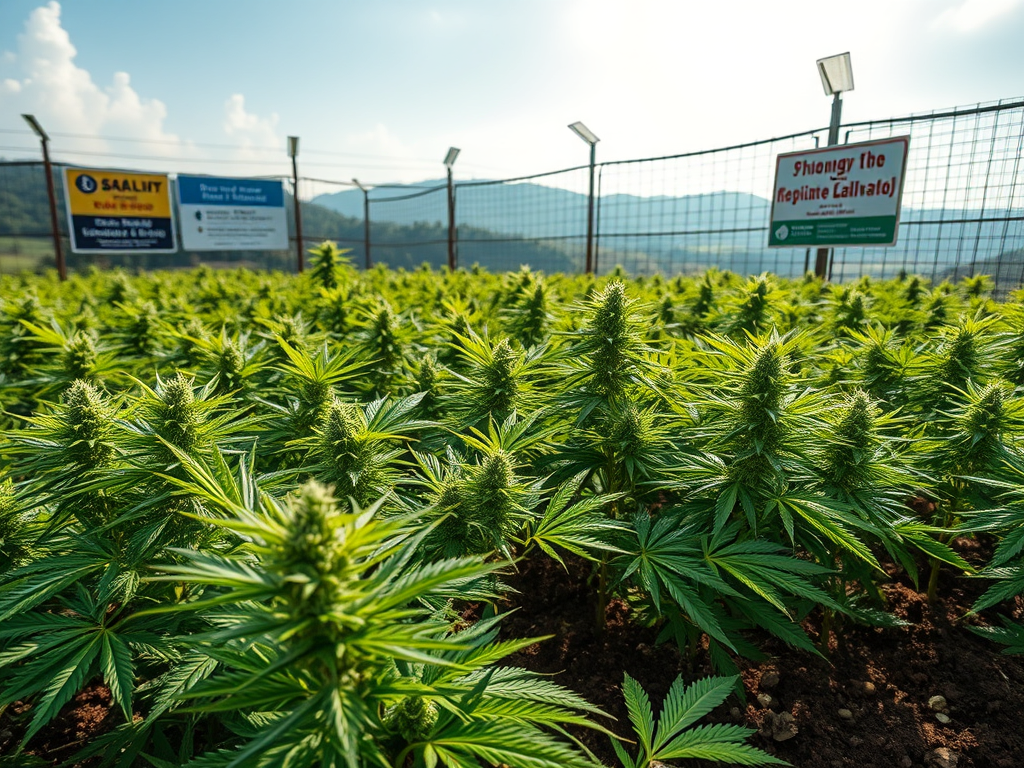
Colombo, Sri Lanka – Sri Lanka has officially granted permission to seven foreign investors to cultivate cannabis legally for the first time, marking a landmark shift in the island nation’s approach to controlled substances. The project is being implemented under the aegis of the Board of Investment (BoI), which selected the investors from a pool of 37 applicants.
Dr. Dhammika Abeygunawardena, former Commissioner General of the Ayurveda Department and supervising officer for the initiative, confirmed that the approvals are subject to strict regulations. Each investor has received a temporary six-month license, with the possibility of extension based on progress reports.
“To ensure full compliance and security, each investor must deposit a USD 2 million bond with the Central Bank of Sri Lanka,” Dr. Abeygunawardena said. “The minimum investment required to initiate a cannabis cultivation venture is USD 5 million.”
The cultivation is confined to 64 acres of BoI-allocated land in Mirigama, and all cannabis produced must be exported for pharmaceutical production and testing purposes. Under no circumstances can the plants or their derivatives be released domestically.
Security measures are stringent: the cultivation area must be fully enclosed, and investors are required to coordinate with the Special Task Force (STF) and local police for round-the-clock protection. The BoI, Ministry of Public Security and Parliamentary Affairs, Ministry of Environment, and Department of Ayurveda jointly oversee the initiative.
Dr. Abeygunawardena emphasized that the government anticipates significant foreign exchange earnings from the program. Former State Minister Diana Gamage, credited with laying the legal groundwork for the project, said the initiative signals Sri Lanka’s readiness to participate in the emerging global medicinal cannabis market while maintaining strict regulatory control.
This move aligns with a broader international trend toward legal, tightly regulated cannabis cultivation for medical and scientific purposes, positioning Sri Lanka as a potential hub in South Asia for pharmaceutical cannabis exports.
Timeline: Cannabis Cultivation Approval in Sri Lanka
Phase 1: Policy and Legal Framework
- Government establishes legal framework for controlled cannabis cultivation.
- Former State Minister Diana Gamage plays a key role in drafting regulations.
- Strict rules defined: cultivation only for pharmaceutical use, all plants must be exported, and no part of the plant can enter domestic circulation.
Phase 2: BoI Project Launch
- Cannabis cultivation initiative launched under the Board of Investment (BoI).
- 37 foreign applicants submit proposals.
- Government allocates 64 acres of land in Mirigama for cultivation.
Phase 3: Investor Selection
- BoI evaluates applications; 7 investors are selected for the first phase.
- Criteria include financial capability, adherence to legal standards, and export focus.
Phase 4: Licensing and Security Measures
- Each selected investor issued a temporary six-month license, renewable based on progress reports.
- Investors must deposit a USD 2 million bond with the Central Bank as a security guarantee.
- Minimum investment required to start cultivation: USD 5 million.
- Cultivation site must be fully enclosed; Special Task Force (STF) and police provide protection.
Phase 5: Supervision and Compliance
- Dr. Dhammika Abeygunawardena supervises the project.
- BoI, Ministry of Public Security and Parliamentary Affairs, Ministry of Environment, and Department of Ayurveda jointly monitor compliance.
- Regular reporting ensures adherence to pharmaceutical-only cultivation and export mandates.
Phase 6: Export and Revenue Generation
- All cannabis must be exported.
- Government expects significant foreign exchange earnings from pharmaceutical cannabis exports.



Leave a comment