
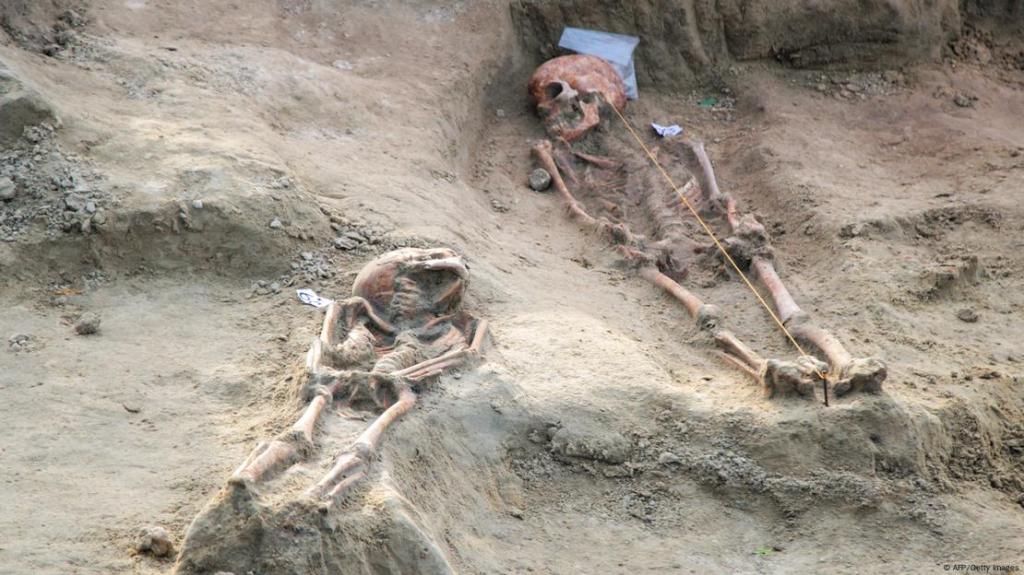
Chemmani, Northern Province – The excavation of a mass grave in Chemmani, on the outskirts of Jaffna, has reopened old wounds in Sri Lanka, forcing the country to confront a legacy of enforced disappearances and mass violence. For decades, Tamil families in the North and East have sought answers for relatives who vanished during the protracted civil war (1983–2009), often surrendering to government forces only to disappear without trace.
Thambirasa Selvarani, a 54-year-old from Ampara District, has been searching for her husband, Muthulingam Gnanaselvam, who disappeared in May 2009. “We don’t know who they’re going to find next,” she told journalists. “I keep thinking about it day and night. I can’t sleep or eat.” Selvarani chairs the Association of Relatives of Enforced Disappearances (ARED) and represents a community that has long lost faith in domestic accountability mechanisms.
The Chemmani Excavation
Archaeologists have uncovered over 140 skeletal remains, including children and infants, with the bodies often “heaped together in a shallow, unmarked fashion.” Observers note evidence that some victims may have been buried alive, as indicated by twisted limbs and bent postures. Personal items such as slippers, milk bottles, and school bags have been recovered alongside human remains, underscoring the civilian nature of the victims.
Chemmani’s significance dates back to 1998, when a Sri Lankan soldier implicated in the rape and murder of schoolgirl Krishanthi Kumaraswamy spoke of hundreds of bodies buried in the area. Subsequent excavations in the early 2000s and more recently in 2025 have failed to deliver accountability, instead highlighting a pattern of impunity and politicization in domestic investigations.
Historical and Legal Context
Sri Lanka has one of the highest numbers of unresolved enforced disappearances globally, with estimates ranging from 60,000 to 100,000 cases, mostly tied to the civil war and the 1987–1989 Marxist (JVP) insurrection. Over the years, the government has established several commissions, including the Lessons Learnt and Reconciliation Commission (LLRC) and the Office on Missing Persons (OMP, 2016). Yet, these institutions have largely focused on reconciliation rather than accountability, and political interference has undermined their credibility.
While Sri Lanka ratified the International Convention for the Protection of All Persons from Enforced Disappearance (ICPPED) and enacted the corresponding domestic law in 2018, the legislation has been largely ineffective. No successful prosecutions or structured investigative procedures exist, leaving families without remedies.
International law, including the Minnesota Protocol (2016), the UN Guiding Principles for the Search for Disappeared Persons (2019), and the Bournemouth Protocol (2020), sets out clear standards for forensic investigations, victim participation, and accountability. These frameworks demand prompt, independent, impartial, and effective investigations, identifying not only perpetrators but also those responsible through the chain of command.
Current Developments and Calls for International Oversight
The 2025 Chemmani-Siththupaththi exhumation has triggered calls for international supervision. The International Commission of Jurists (ICJ) and the UN High Commissioner for Human Rights (OHCHR) emphasize that Sri Lanka lacks both the technical expertise and the political will to manage mass grave investigations independently.
Mandira Sharma, ICJ Senior Legal Adviser, said:
“Behind every set of remains lies a family that has endured unimaginable suffering. Forensic investigations must respect human dignity and involve the full participation of families. International oversight is required to ensure that these processes meet the highest professional and legal standards.”
During a site visit in June 2025, UN High Commissioner Volker Türk highlighted that domestic mechanisms remain insufficient and that Sri Lankans continue to look to the international community for justice. Tamil activists, including Selvarani, protested alongside his visit, expressing distrust in the government’s commitment to accountability.
Political Dynamics and Challenges
In September 2024, leftist President Anura Kumara Dissanayake assumed office, signaling a departure from dynastic politics. However, skepticism persists. Legal experts and human rights defenders argue that past governments have consistently resisted international involvement in accountability processes, leaving structural and systemic barriers in place. Dissanayake has indicated he does not intend to prosecute those responsible for war crimes, further eroding public confidence.
The OMP currently observes the Chemmani excavation, but analysts stress that mere observation is insufficient. Effective investigations require transparent procedures, international expertise, family participation, and secure handling of evidence to enable potential criminal accountability.
The Path Toward Transitional Justice
The Chemmani excavation represents a critical juncture for Sri Lanka’s transitional justice process. Scholars and human rights organizations argue that the investigation must be more than a forensic exercise; it must integrate:
- Independent oversight: International forensic experts and human rights observers from the OHCHR, ICJ, or ICRC to ensure credibility and impartiality.
- Victim-centred processes: Legal, psychosocial, and protective support for families, with participation at all stages.
- Evidence preservation: Documentation to maintain the chain of custody for future prosecutions.
- Accountability frameworks: Establishment of a Special Office to investigate and prosecute serious crimes by state actors.
- Transparency and truth-telling: Public disclosure of findings and consistent updates to families.
The UN Human Rights Council has repeatedly mandated international monitoring, including through the Sri Lanka Accountability Project, yet resolutions remain contingent on political will. Failure to act risks leaving the Chemmani exhumations as another episode in a pattern of impunity, rather than a model of justice and reconciliation.
Conclusion: Memory, Justice, and Hope
For families like Selvarani’s, hope is fraught with anxiety: years of delayed or failed investigations have conditioned Tamil communities to distrust official processes. Yet the Chemmani exhumations offer a rare, critical opportunity for Sri Lanka to confront its past with integrity and transparency.
Properly conducted, this investigation could set a precedent for other mass grave sites, ensuring that victims of enforced disappearances are remembered, and that perpetrators are held accountable. Without such measures, the cycle of impunity risks continuing, leaving the trauma of war unhealed and the promise of justice unrealized.
As the ICJ emphasizes, the credibility of Sri Lanka’s transitional justice commitments hinges on whether the Chemmani exhumations are conducted in strict compliance with international law, with meaningful international oversight, and with the full engagement of the victims’ families.
🕊️ Mass Grave Discoveries
- 1998 – Chemmani: A Sri Lankan Army corporal implicated in crimes testified that hundreds of bodies of missing Tamils were buried in Chemmani, northern Sri Lanka. This became the first high-profile mass grave site drawing international attention.
- Early 2000s – Chemmani excavations: Archaeologists uncovered multiple mass graves, including remains of civilians, some of whom showed signs of being buried alive.
- 2018 – Mannar: Discovery of a mass grave containing 298 individuals, including women and children, further highlighted Sri Lanka’s legacy of wartime atrocities.
- 2025 – Chemmani-Siththupaththi, Jaffna: Excavations revealed 140 skeletons, including children and infants, prompting renewed calls for international oversight and transparent forensic investigation.
🏛️ Lessons Learnt and Reconciliation Commission (LLRC)
- May 2010 – LLRC established by President Mahinda Rajapaksa to investigate the causes of the civil war and recommend measures for national reconciliation.
- November 2011 – LLRC submitted its final report, acknowledging serious human rights violations but criticized for limited focus on accountability and prosecutions.
🏢 Office on Missing Persons (OMP)
- May 2016 – Sri Lankan Parliament passed legislation to establish the OMP, aimed at investigating enforced disappearances.
- September 2017 – OMP officially established as an independent institution.
- February 2018 – OMP began operations with appointed members tasked with investigating disappearances.
- 2025 – OMP continues to operate, but its effectiveness is questioned due to politicization, limited independence, and lack of public trust.
🌐 United Nations Resolutions and Actions
- 2015 – UN Human Rights Council (UNHRC) resolution adopted, calling for transitional justice mechanisms in Sri Lanka, including a truth commission and judicial process with international participation.
- 2017 – UNHRC resolution urged Sri Lanka to implement its transitional justice commitments, including investigation and accountability for wartime abuses.
- 2021 – UNHRC adopted Resolution 46/1, emphasizing accountability and the establishment of a truth-seeking mechanism.
- 2025 – UNHRC set to review continued international scrutiny of Sri Lanka’s human rights situation in light of the ongoing Chemmani-Siththupaththi exhumations.
Summary
From 1998 to 2025, Sri Lanka has seen repeated mass grave discoveries, including Chemmani and Mannar, which continue to highlight unresolved human rights abuses. Domestic mechanisms such as the LLRC and OMP were established to address these issues, but progress has been slow and often questioned for independence and effectiveness. The UN has consistently urged Sri Lanka to implement transitional justice measures and ensure accountability, making international oversight critical as new evidence and exhumations continue to emerge.



Leave a comment