
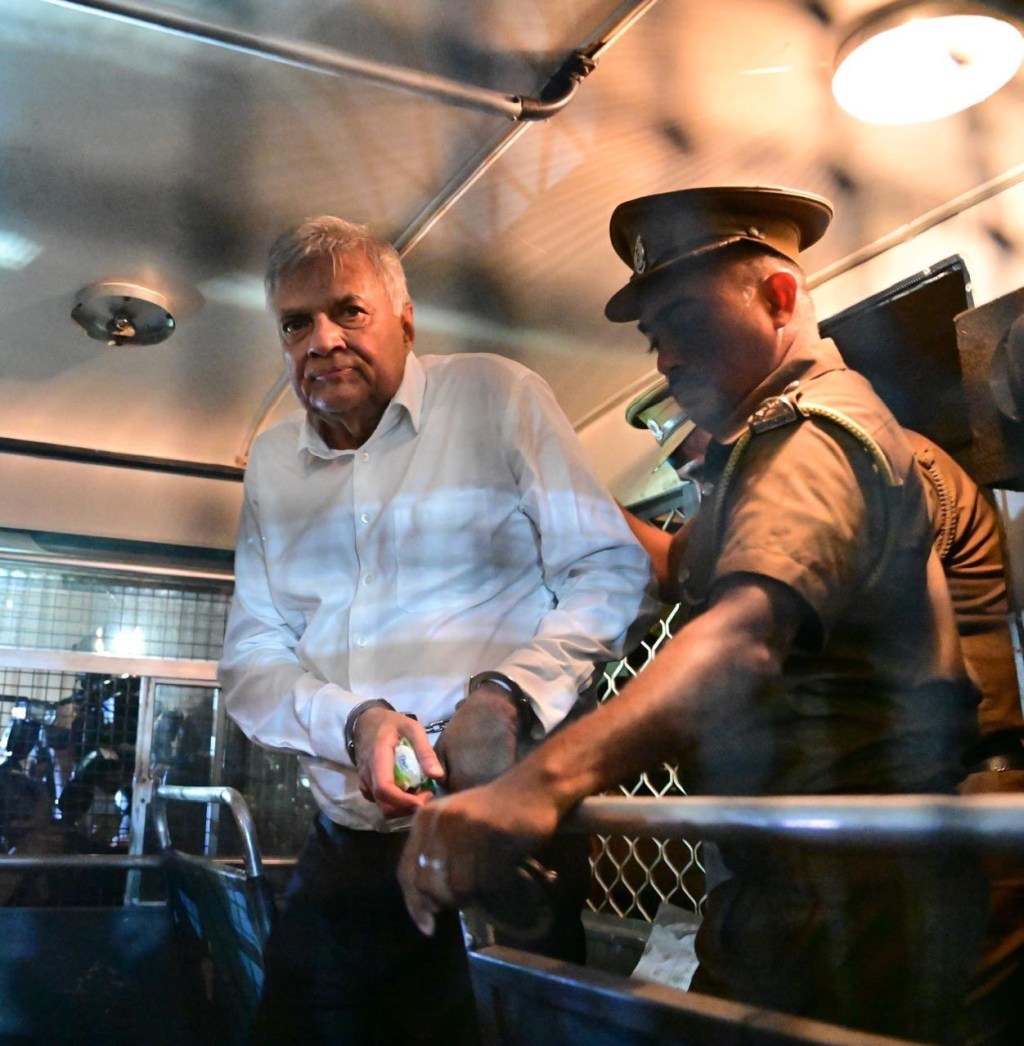
Colombo — The arrest of former President Ranil Wickremesinghe marks a dangerous low point in Sri Lanka’s political culture. It is not accountability—it is vengeance. It is not justice. It is a calculated effort to destroy the reputation of the one leader. He dared to do what others would not. He rescued a nation from the brink of total collapse.
A Nation on Fire
When Wickremesinghe assumed power in 2022, Sri Lanka was in free fall. Foreign reserves had evaporated, inflation surged past 70%, and families queued for hours for fuel, medicine, and food. Streets were paralyzed by protests. The state was bankrupt—financially, politically, and morally.
Wickremesinghe inherited not power, but rubble. And unlike others who fled responsibility, he stayed. Within months, he negotiated a $2.9 billion IMF bailout, restructured international debt, and restored the credibility of the Central Bank. He implemented painful reforms. These included removing subsidies, rationalizing imports, and reforming state enterprises. Ordinary Sri Lankans loathed these changes, but economists agreed they were essential for survival.
By 2024, inflation had dropped to single digits, reserves were rising again, and the currency had stabilized. The lights were back on. Essential goods returned to shelves. Chaos was replaced by a fragile but real stability.
Building a Global Voice
Wickremesinghe’s diplomacy lifted Sri Lanka from isolation. He re-engaged with Japan, India, the EU, and global lenders. He brought the country back into the conversation at Davos, the UN, and the Non-Aligned Movement. He restored the trust of creditors by passing the Central Bank Act, insulating monetary policy from political manipulation.
In a region defined by political theatrics, he was a rare statesman. He understood that credibility, not slogans, is the true currency of survival.
The Pragmatist, Not the Populist
Ranil Wickremesinghe was never a populist. He did not thrive on emotional speeches or nationalist grandstanding. He was pragmatic, often aloof, sometimes misunderstood. But when the nation faced its gravest threat since independence, he did what no one else dared: he stabilized it.
That very pragmatism is now being punished. His arrest—while his wife battles cancer—is not about corruption or accountability. It focuses on erasing his legacy. The goal is to neutralize his influence. They want to ensure that a sober voice of reason is absent. They do not want a voice that disrupts a system increasingly defined by vendettas and opportunism.
A Dangerous Precedent
Sri Lanka is a democracy that has weathered a civil war, terrorism, and economic collapse. But the persecution of a leader who prevented outright state failure sends a chilling message: no good deed goes unpunished. If crisis management results in political humiliation, why would any future leader take the risk? Sacrifice for the greater good also leads to political humiliation. Making unpopular but necessary decisions would seem even less appealing.
The timing is cruel. The optics are shameful. And the damage to Sri Lanka’s democratic credibility will be lasting.
History’s Verdict
History will not remember Ranil Wickremesinghe as a populist hero. It will remember him as the reluctant statesman who kept Sri Lanka alive when the nation was gasping for breath.
Those who orchestrated his downfall celebrate today, but history’s judgment will be merciless. For Sri Lanka, the arrest of Ranil Wickremesinghe is not just an attack on a man. It is an attack on the very idea of responsible leadership.
Timeline of Ranil Wickremesinghe’s Role in Sri Lanka
1977 – First Elected to Parliament
- Entered Parliament as the youngest cabinet minister in J.R. Jayewardene’s government.
- Served as Minister of Youth Affairs and Employment, building his reputation as a modernizer.
1993 – Appointed Prime Minister (First Term)
- Became Prime Minister after President Ranasinghe Premadasa’s assassination.
- Focused on economic reforms, trade liberalization, and rebuilding investor confidence.
2001 – Returns as Prime Minister (Second Term)
- Took office during civil war tensions.
- Signed a Norwegian-brokered ceasefire with the LTTE in 2002, bringing temporary peace and opening space for dialogue.
- Pushed forward with privatization and pro-market reforms that attracted foreign investment.
2015 – Prime Minister Again (Third Term)
- Came to office under President Maithripala Sirisena.
- Advocated for democratic reforms, good governance, and a new constitution.
- Played a key role in improving relations with the West after years of isolation under the Rajapaksa regime.
2019 – Easter Sunday Attacks Fallout
- Criticised for intelligence failures but defended democratic checks and balances against authoritarian overreach.
July 2022 – Assumes Presidency Amid Collapse
- Parliament elects Wickremesinghe president after Gotabaya Rajapaksa fled the country during mass protests.
- Inherits an economy with empty reserves, triple-digit inflation, and no fuel, food, or medicine.
- Brings calm by restoring state authority and security during chaos.
September 2022 – IMF Bailout Negotiations
- Secures staff-level agreement for a $2.9 billion IMF bailout.
- Begins implementing painful reforms, including tax hikes and subsidy cuts, despite public backlash.
2023 – Economic Stabilization
- Inflation falls from 70% to below 10%. Fuel and food supplies normalise.
- Debt restructuring talks with international creditors move forward.
- Central Bank Act passed, ensuring independence of monetary policy.
2024 – Renewed International Credibility
- Hosts foreign leaders and re-establishes global partnerships with Japan, India, and the EU. Speaks at global economic forums, restoring Sri Lanka’s image after bankruptcy.
- Oversees the early signs of growth returning, marking the first steps out of economic crisis.
2025 – Arrest and Political Targeting
- Wickremesinghe is arrested by the government in what critics describe as a witch-hunt.
- The move sparks outrage among civil society. Many view it as political revenge against the leader who stabilized the country.
- His detention comes as his wife battles cancer, compounding the perception of cruelty and vindictiveness.
The Relentless Fall of a Reluctant Statesman
Ranil Wickremesinghe has never been the most popular politician in Sri Lanka. He was often derided as aloof, technocratic, even unelectable. Yet time and again, when the country descended into chaos, it was Wickremesinghe who steadied the ship. Now, at the twilight of his career, the man who pulled Sri Lanka back from collapse faces a humiliating arrest. Many call this a government witch-hunt. Meanwhile, his wife battles cancer.
His career stretches across nearly five decades, intertwined with Sri Lanka’s deepest crises. He entered parliament in 1977, the youngest cabinet minister in J.R. Jayewardene’s government. Even then, Wickremesinghe was seen as a moderniser. He was tasked with youth and employment. He worked on bridging the gap between a restless population and a rigid state.
By 1993, he was thrust into the prime minister’s chair after the assassination of President Ranasinghe Premadasa. Though his first tenure was short, it marked the beginning of a pattern: Wickremesinghe was always called upon during emergencies. In 2001, he returned to power, steering Sri Lanka through the brutal civil war. His boldest gamble came in 2002, when he signed a ceasefire agreement with the Tamil Tigers. It was fragile and deeply controversial. Ultimately, it collapsed. But for a brief moment, it brought relief to a country exhausted by decades of bloodshed.
The story repeated in 2015, when Wickremesinghe again became prime minister under Maithripala Sirisena’s presidency. This time, his focus was on governance reform. He opened Sri Lanka back to the West after years of diplomatic isolation under the Rajapaksas. He focused on pushing constitutional reforms, good governance, and reconciliation. He was not a populist, but a reformer — and reformers rarely win popularity contests.
The lowest point of his premiership came in 2019, when the Easter Sunday bombings exposed catastrophic failures in intelligence coordination. Wickremesinghe defended democratic checks and balances, but the tragedy weakened his grip on power.
Then came 2022, the darkest year in Sri Lanka’s modern history. Economic collapse brought the country to its knees. Fuel stations ran dry, families skipped meals, medicine vanished from hospitals. The Rajapaksas fled. Ranil Wickremesinghe stepped into the chaos. He was not elected by the people. Parliament chose him as a last resort.
It was a thankless role. He raised taxes, cut subsidies, and braced the public for austerity. But it worked. Inflation decreased. It fell from 70 percent to single digits. Food and fuel returned to the shelves. Sri Lanka secured a $2.9 billion IMF bailout — the very first step in crawling out of bankruptcy. By 2024, debt restructuring talks advanced, and foreign leaders began returning to Colombo. For the first time in years, Sri Lanka’s name abroad was not synonymous with disaster.
Yet Wickremesinghe’s pragmatism was never rewarded at home. He was too closely associated with elites, too disconnected from the street, too blunt when the people wanted warmth.
And now, in 2025, he is under arrest. The very political class that once leaned on him to save the state accuses him. For his supporters, it is nothing short of vindictive. “This is not justice. This is vengeance,” one Colombo lawyer remarked. This sentiment echoes a growing chorus that sees the move as a brutal erasure of Wickremesinghe’s legacy. The timing is cruel. As he faces political humiliation, his wife battles cancer. This private suffering is made public by the spectacle of his arrest.
Wickremesinghe’s career was defined not by sweeping popularity. It was not defined by populist charm either. Instead, it was defined by a relentless willingness to govern when others would not. He was, in many ways, Sri Lanka’s reluctant statesman — the man called upon in crisis, and abandoned in calm.
“History will judge him differently from the way the street does,” said a retired diplomat in Colombo. “He made hard decisions when no one else dared. He rebuilt bridges with the world. He gave Sri Lanka breathing space when it was gasping for air.”
Today, as his political enemies celebrate his downfall, Sri Lanka risks forgetting one important truth. This truth has repeated itself for nearly half a century. When the nation was collapsing, Ranil Wickremesinghe was the one who held it together.
The Reluctant Statesman: Ranil Wickremesinghe’s Legacy and the Peril of Political Vengeance
For decades, whenever Sri Lanka staggered to the edge of collapse, Ranil Wickremesinghe was summoned to steady it. Now, the 76-year-old former president finds himself in custody. Many accuse him of being the victim of a political witch-hunt. He is humiliated at the twilight of his career. Meanwhile, his wife quietly battles cancer.
His arrest has shocked Colombo’s political class. International observers are also shocked. They remember him as the architect of Sri Lanka’s most painful but necessary reforms.
From young technocrat to reluctant crisis manager
Wickremesinghe’s story began in 1977, when he entered parliament under J.R. Jayewardene. He was the youngest cabinet minister of the era, tasked with youth and employment. In the 1980s and 1990s, he steadily rose through the ranks. He was known less for fiery rhetoric. He was recognized more for his administrative discipline.
When President Ranasinghe Premadasa was assassinated in 1993, Wickremesinghe briefly served as prime minister. His real test came in 2001, when he once again took office amidst economic crisis and war.
In 2002, he signed the historic ceasefire agreement with the Tamil Tigers. It was fragile and controversial. Ultimately, it collapsed. But for a moment, it gave Sri Lankans a reprieve from decades of bloodshed. “He was willing to take political risks to stop the war,” recalls one retired diplomat. “He was not rewarded for it, but history will remember.”
Reformist instincts, unpopular choices
Wickremesinghe was always more reformer than populist. As prime minister in 2015 under President Maithripala Sirisena, he pursued constitutional reform, anti-corruption initiatives, and reconciliation. He rebuilt ties with the West after years of isolation under the Rajapaksa family.
But tragedy struck in 2019, when the Easter Sunday bombings revealed catastrophic intelligence failures. Though he defended democratic checks and balances, his reputation never fully recovered.
2022: Sri Lanka’s darkest hour
In 2022, Sri Lanka was on the brink of collapse. Fuel stations ran dry, families skipped meals, and hospitals went without medicine. The Rajapaksas fled. Into this chaos, parliament turned to Wickremesinghe — a man many voters had rejected, but whose competence was undeniable.
It was perhaps the hardest assignment of his career. He imposed austerity, raised taxes, and negotiated with the International Monetary Fund. By 2023, inflation fell from nearly 70 percent to single digits. Fuel and food returned to shelves. The country began restructuring its $83 billion debt.
“Without Wickremesinghe’s leadership, Sri Lanka would have slipped into outright state failure,” said an IMF official in Washington.
International recognition, domestic rejection
World leaders acknowledged his steady hand. New Delhi saw him as a pragmatic partner who stabilised Sri Lanka’s foreign policy. The European Union and the United States quietly welcomed his governance reforms. The IMF hailed him as the indispensable negotiator who brought fiscal discipline to a bankrupt state.
At home, however, he remained deeply unpopular. His ties to Colombo’s elite made him seem distant from ordinary people. For many Sri Lankans struggling with austerity, he was the face of pain rather than recovery.
Arrest and humiliation
Now, in 2025, Wickremesinghe is behind bars. His supporters say his arrest is a political vendetta, designed to erase his legacy ahead of fresh elections. The cruelty of timing — as his wife, Prof. Maithree Wickremesinghe, fights cancer — has only deepened public unease.
“This is not justice. This is vengeance,” said one Colombo lawyer. “Whatever his political flaws, he saved this country from collapse more than once. To drag him down like this dishonours the state itself.”
The reluctant statesman’s legacy
Wickremesinghe’s career was never defined by mass popularity. He was often mocked for his stiff manner, his lack of charisma, his failure to win over crowds. Sri Lanka was gasping for survival in 2001, in 2015, and in 2022. Each time, Wickremesinghe stepped forward.
“History will not judge him by elections won or lost,” said a former Indian diplomat. “It will judge him by whether Sri Lanka survived. And it did.”
As his political enemies celebrate his downfall, Sri Lanka risks forgetting the central truth of his career. Ranil Wickremesinghe was the reluctant statesman. He held the country together when no one else.

Leave a comment