
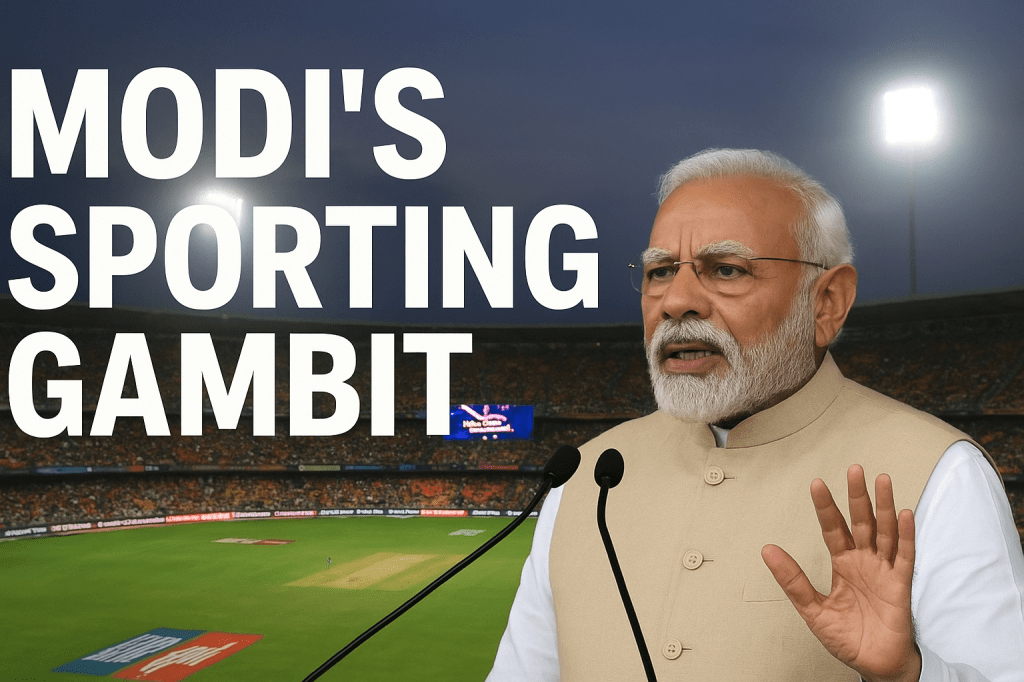
New Delhi, India — Prime Minister Narendra Modi has increasingly turned sport into a political stage. His government has initiated towering stadium projects. They have launched mass fitness campaigns and organized headline-grabbing cricket spectacles. Athletics have been woven into the broader narrative of national pride. Admirers view this as a bold attempt. They see it as a way to build a sporting culture in a country long obsessed with cricket. India has been lagging in Olympic achievement. Critics, however, argue it is a calculated display of insecurity. They claim it’s a way to merge politics with spectacle and distract from domestic challenges. It fuses the prime minister’s image with the roar of the crowd.
The Instruments of a Sporting State
Modi’s imprint on Indian sport is visible everywhere. The world’s largest cricket ground in Ahmedabad now bears his name. It is called the Narendra Modi Stadium. This is a symbolic fusion of political persona and national pastime. Programs such as Khelo India and Fit India have rolled out across schools and communities. New legislation on sports governance has been presented. This is part of a national mission to revive sporting excellence.
Athletes are regularly feted at grand ceremonies. Medalists are invited to the prime minister’s residence. Major tournaments are staged with theatrical pomp. Modi’s presence is seen at stadium openings, World Cup ceremonies, or fitness rallies. It is designed to inspire participation. It also aims to project his leadership as synonymous with national resurgence.
Where Sport Meets Politics
Sport in India has always carried cultural weight, but under Modi it has been explicitly drawn into the political arena. Renaming the Motera stadium after a sitting prime minister was not only an act of civic infrastructure. It was also a deliberate statement of personal branding.
During marquee cricket matches, particularly those against Pakistan, the atmosphere of nationalism has been harnessed to project political strength. The 2023 World Cup demonstrated that sport could be staged as a national spectacle. Ceremonies highlighted the government’s role in delivering global-scale events. Observers noted the timing of policy pushes and inaugurations. These often coincided with election cycles. This provided a stream of positive imagery. It outshone uncomfortable debates on unemployment, inequality, or civil liberties.
Insecurity Behind the Spectacle
Why would a leader with a commanding electoral record lean so heavily on sport? Analysts point to political psychology. Leaders with strong personal brands feel pressure to reinforce legitimacy. This happens when they face dissent, criticism, or slowing economic momentum. In such moments, spectacle becomes a defensive tool.
Stadiums and tournaments provide visible triumphs — easily televised, emotionally powerful, and broadly popular. They allow leaders to script a narrative of renewal and rising glory, which in turn deflects attention from divisive issues. Cricket, already a vessel of mass emotion, offers a perfect stage to nationalize pride and dilute critique. For some, this is evidence of insecurity: the sense that legitimacy must be constantly reinforced with symbolic victories.
The Risks of Blending Sport and Politics
The political payoff is undeniable, but it comes at a cost. When stadiums and tournaments are used as monuments to a leader, questions arise about inclusivity and equity. Minority communities may feel excluded from the narrative. Opposition voices may also feel marginalized when sport is defined as an emblem of a singular political identity.
Massive infrastructure projects absorb state resources, sometimes overshadowing investments in grassroots training, education, or healthcare. Critics warn that ribbon-cutting ceremonies generate immediate headlines but leave behind uneven benefits. Sport can be a tool of diplomacy. Overt politicization risks fueling tensions with neighbors. This is especially true when India-Pakistan matches are infused with nationalist rhetoric.
Concrete Examples
- Narendra Modi Stadium: The Motera cricket ground was renamed after the prime minister himself. This change is hailed as a symbol of national pride. However, it is also criticized as self-branding.
- Cricket World Cup ceremonies: Tournaments are used to showcase India’s rise. Government visibility is carefully staged. This links success on the field with political leadership.
- Khelo India and Fit India: Programs that promote fitness and grassroots sport. They are rolled out with strong central branding. The timing is aligned with electoral cycles.
- Athlete patronage: Frequent public appearances with medalists, using sporting success as evidence of national revival under Modi’s leadership.
Ambition and Insecurity, Intertwined
The sports strategy reflects both ambition and insecurity. India genuinely seeks a stronger global sporting presence. The nation wants Olympic medals and a reputation as host of world-class events. On the other hand, projects are heavily personalized. The use of sport generates electoral momentum. The timing of initiatives suggests a defensive dimension. These are attempts to shore up legitimacy through mass spectacle.
What It Means for India
Domestically, the merging of sport and politics risks politicizing fandom and diverting attention from governance debates. Internationally, it enhances India’s profile but also carries the risk of over-nationalizing sporting events, which can complicate relations with neighbors.
The challenge lies in balance. Sport can and should inspire pride, build health, and showcase talent. But when it becomes a stage-managed extension of political image-making, its unifying spirit risks being fractured.
Final Assessment: Modi’s sporting gambit is both a story of nation-building and political insecurity. It builds stadiums, funds youth programs, and boosts India’s international image. Yet it also harnesses the euphoria of the crowd. This enthusiasm is used for political ends. It transforms the playing field into a theatre of power.
When Applause Becomes Politics: Modi, India-Pakistan Cricket, and the Spectacle of Power
Cricket is often described as more than a sport in South Asia. Under Prime Minister Narendra Modi, it has become a strategic instrument in India’s political arsenal. It is a tool for projecting strength. It also helps shape national identity and deflect criticism. The latest flare-up in this dynamic comes from the Asia Cup in Dubai. A handshake controversy between Indian and Pakistan players became the latest act in an ongoing drama of national posturing. Modi has invested in stadiums, mass fitness programs, and high-visibility events. This pattern reveals a leader not content with merely governing. He is intent on forging spectacle into legitimacy.
This article explores the interaction between Modi’s sporting gambits and political narratives. It examines how the India-Pakistan cricket rivalry amplifies them. The article also delves into the risks behind a strategy that blends sport and state.
I. The Handshake in Dubai: Symbolism, Fury, and What It Signals
During the Asia Cup matches in Dubai, United Arab Emirates, Indian players refused an informal handshake toward their Pakistani counterparts. This act ignited headlines. Officials dismissed it as a misunderstanding or a sportsmanship lapse. However, the media and public reaction treated the gesture as emblematic. It symbolized nationalism over comradeship. Boundary lines are drawn by identity rather than cricket.
- Such moments do not matter for their immediate effect on the game. They are significant for how they fit into a broader narrative. This narrative portrays India under Modi as a proud and assertive nation. It demands respect and maintains distance from rivals. Critics argue this follows a deliberate calculation. These are public gestures that reinforce us-versus-them divides. Such gestures are useful in mobilizing support. They reinforce a leader’s image as both protector and icon.
- The controversy followed India’s dominant on-field performance. It also came at a moment when political tensions were visible. These included regional economic distress, dissent over civil liberties, and debates about social inclusion. Many commentaries saw the refusal to shake hands as a metaphor. In Modi’s India, sport is no longer just diplomacy. It has become part of political theatre.
II. The Architecture of Spectacle
To understand recent antics, it helps to map the deeper architecture of what has been built over time:
- Stadiums as State Monuments. The Narendra Modi Stadium in Ahmedabad is more than a cricket venue: it is a physical manifesto. The stadium is named after a living prime minister. This followed months of media coverage, turning venues into memorials to the current ruler.
- Programmatic Pushes. Initiatives like Fit India and Khelo India, scheduled inaugurations, and legislative reforms align with electoral and narrative cycles. Investment in grassroots, youth participation, and infrastructure bolster credibility. But their timing is rarely apolitical.
- Celebrity and Rituals. Modi’s frequent presence at matches, award ceremonies, or performances by athletes turns sports figures into symbols. Medalists become political actors when celebrated on big screens, speeches, and mass events. The broader civic fabric — press, regional parties, fan clubs — all play roles in amplifying this effect.
III. Political Needs Behind the Play
Why has Modi leaned so heavily into this public spectacle of sport? Several overlapping motivations emerge.
- Legitimacy under Pressure. As India faces economic pressures, inequality, and religious tensions, it also encounters frequent criticism about democratic backsliding. In response, spectacle becomes a way to anchor national pride. When roads are broken or public services lag, a well-staged stadium can provide a sense of progress. A winning cricket match can further support this counter-narrative.
- Identity Politics. Cricket is deeply woven into Indian identity. The India-Pakistan rivalry is perhaps the greatest symbolic trigger in this context. Moments of sportsmanship or hostility are amplified to signal broader political identities: patriotism, toughness, respect.
- Soft Power and global image. Hosting international matches pushes India as a destination for tournaments. Enhancing infrastructure says something to the world. It shows that India is modern, capable, and rising. Modi’s branding of national projects, including in sport, aims at both domestic approval and international prestige.
- Control of Narrative. Sport allows control over media cycles. Big events mean media attention, often overshadowing controversies of governance, dissent, or social unrest. When the spotlight is on cricket, stories about protest or discontent struggle to get equal coverage.
IV. Tensions, Costs, and the Societal Divide
This strategy, however, carries risks and costs. The same optics that can burnish political capital may seed disaffection, deepen division, or expose contradictions.
- Cultural Polarization. Nationalist sports narratives tend to simplify. Minorities or dissenting voices may feel excluded. When fans, commentators, or politicians demand symbolic loyalty refusing handshakes, for example — they reinforce divisions rather than unity.
- Opportunity Costs. Massive funds and attention are directed to marquee stadiums and global events. This focus sometimes overlooks local infrastructure. There are also consequences for rural public health and vital public services. When visible success is prioritized over equitable delivery, citizens may begin to see a gap between spectacle and substance.
- Weariness and Diminishing Returns. Over time, spectacle may cease to distract. If citizens feel that their everyday lives are still under strain, it may create a gap. Jobs, rights, and security are key areas of concern. This gap may breed cynicism rather than loyalty.
- International Satiety. Diplomacy via sports only works to a point. Neighboring countries and global observers may critique politicized gestures, especially where human rights issues arise. Repeated conflation of political identity with sport risks diplomatic blowback. This is particularly relevant in the India-Pakistan context. It also applies in multilateral forums.
V. Recent India-Pakistan Episodes: More Than Cricket
To see the strategy in full, one must consider how the India-Pakistan rivalry has been leveraged:
- India-Pakistan Matches as Diplomatic Barometers. Matches draw heavy security, political commentary, and deeply polarized coverage. Success on the field becomes political capital, and losses become contested terrain in national narratives.
- The Asia Cup and the Handshake. As mentioned, refusal to shake hands in Dubai during Asia Cup took on meaning far beyond sportsmanship. It was widely perceived as a political message: distance, superiority, diplomatic posture.
- Government Messaging. During these events, government press and allied media use cricket victories. They use symbolic gestures to reinforce narrative themes like “India is respected” and “We demand decency.” They frame sport wins as moral wins.
VI. What This Means for India’s Domestic Politics and Foreign Relations
- Effect on Elections. This strategy can help mobilize support among certain constituencies: middle classes, nationalist voters, diaspora communities. It can deepen loyalty where governance cannot alone satisfy expectations.
- Soft Power Gains vs. Credibility Costs. Internationally, India benefits when it hosts successful tournaments or shows technological or stadium-building prowess. Politicizing gestures such as handshakes or stadium names may reduce credibility. This is especially true when India faces criticism for rights violations, religious tension, or press restrictions.
- Comparative Precedents. Other nations — Turkey, China, increasingly many others — have similarly used sport and mass spectacle to reinforce political legitimacy. The risk is that once spectacle becomes primary political currency, dissent becomes harder to accommodate.
VII. A More Insecure Modus Operandi
Specifically relating to Modi, this constellation suggests growing insecurity even amid electoral dominance:
- The personalization of infrastructure includes stadiums named after him. Inaugurations with large visual presence also suggest a leader conscious of legacy and image.
- The emphasis on “our team” and national strength suggests a need to be seen as central. Making India the center of Asian sport options shows it as capable. It also indicates a desire to be resurgent.
- Distancing gestures (e.g. refusing handshakes) reflect performance of assertiveness in moments of diplomatic limbo.
VIII. Where It Could Lead
If this path continues, here are possible scenarios:
- Escalated politicization. More laws regulating sport federations, greater control of sports media, and increased intertwining of sport with state identity.
- Resistance and backlash. Civil society, media, and minority communities may push back. They may demand neutrality in sport. They could critique the misuse of public funds. They may also highlight governance deficits.
- Foreign policy consequences. India’s cricket diplomacy with Pakistan may become more difficult. There might be a decline in goodwill gestures. India may even use bans or boycotts as political signals.
- Institutional strain. Federations may lose autonomy; legitimacy of sports bodies may be questioned if they become too visibly aligned with political agendas.
Conclusion
Narendra Modi’s strategy of merging sport with politics is not accidental or incidental. Sport offers him a platform aesthetically vivid, emotionally resonant — that few other policy fields provide. It helps craft a narrative of modern India, capable, proud, rising. But it also reveals a deeper concern. Political legitimacy is fragile. Governance cannot alone sustain popularity. Spectacle must augment substance.
The India-Pakistan cricket rivalry is a significant event. The Asia Cup handshake episode also holds importance. Other significant events include the renaming of stadiums and mass public fitness drives. They are not just about judo techniques or crowd turnout. They are about what identity India projects to itself and to the world. Spectacles make good headlines; reality makes elections. For India’s democracy, the challenge is to ensure that applause does not become the only metric of legitimacy. It must also make certain that performance does not displace participation. Additionally, the nation’s gaze should remain wide. It should focus not only on the stadium but also in schoolyards, clinics, courts, and the lives of the marginalized.


Leave a comment