
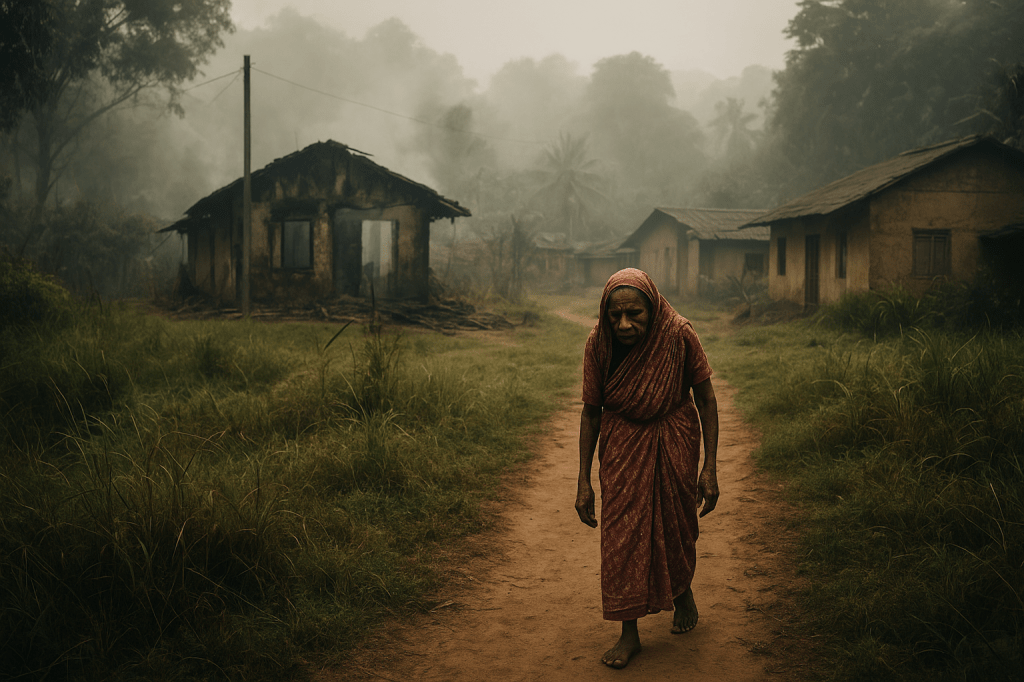
KAHAWATTE, SRI LANKA – There was a series of unsolved murders in rural Sri Lanka. These incidents exposed more than just a local crime wave. It revealed the corrosion of trust. There was a decay of institutions. It also showed the quiet complicity of power.
A Village Living with Ghosts
Kahawatte is a town nestled in Sri Lanka’s gem rich Ratnapura district, should have been known for its tea estates and tranquil valleys. Instead, it became infamous for a string of murders so brutal and repetitive that they would scar the national conscience for years.
Between 2008 and 2015, at least eighteen women most of them elderly and living alone were found raped, strangled, or hacked to death across the villages of Kotakethana, Dimbulwela, Warapitiya, and Opathawatte. Many of their homes were set ablaze after the killings, leaving behind not only ashes, but fear.
By the time the fifteenth victim was buried, Kahawatte had become a case study in state failure. Policing collapsed, and social services disappeared. Silence became a survival strategy.
The Timeline of Terror
Between July 2008 and September 2015, the killings followed an eerie rhythm. Each year brought new victims, all within a few kilometers of one another. The murders were not random — they unfolded as if chronicling the slow breakdown of a rural society.
| Date | Victim(s) | Details | Status / Outcome |
|---|---|---|---|
| 21 July 2008 | Sellaiyah Mariamma (56) | First known case. Resident of Opawatta, Kotakethana. Raped and strangled; house set ablaze. | One suspect arrested, still in remand; case pending AG’s advice. |
| 19 Nov 2008 | Female (52) | Strangled in Kotakethana. | Four suspects arrested, later released in July 2011 for lack of evidence. |
| 4 June 2010 | Female (48) | Murdered in Kotakethana. | One suspect arrested; case still pending. |
| 21 Dec 2010 | Heenmenika (80) | Resident of Dimbulwela. Suspect confessed to this and two previous murders. | One suspect in remand. |
| 3 Apr 2011 | Karunawathi (66) | Murdered in Kahawatte. | One suspect arrested July 2011; case postponed pending AG’s advice. |
| 30 May 2011 | Heenmenike (85) | Resident of Nugawela, Kahawatte. | One suspect arrested, later released on bail. |
| 18 June 2011 | Jayanthi Menike (56) | Murdered in Dimbulwela. | Suspect arrested and remanded. |
| 15 Dec 2011 | Bandara Menike (69) | Resident of Opathapara, Kotakethana. | Suspect arrested; case directed to High Court. |
| 31 Jan 2012 | Nayana Nilmini (52) & Kavindya Chathurani (19) | Mother–daughter double murder at Pansala Para. | Four suspects arrested; one released on bail, went missing. Case ongoing. |
| 30 May 2012 | Dayawathi (61) & Thilakawathi (53) | Sisters burnt inside their house at Warapitiya. | Suspect arrested; later released on bail; committed suicide. |
| 19 July 2012 | Premawathi (63) & H.D. Pushpakumari (32) | Mother–daughter murdered; house set on fire. | Three suspects arrested; all acquitted May 2015. |
| 31 Oct 2012 | Chandrawathi (66) | Murdered in Warapitiya, Kahawatte. | No suspects found; investigation ongoing. |
| 21 Oct 2014 | J. Thilakarani (31) | Body found floating in river, Opathawatte. | Two suspects arrested; remanded. |
| 4 Apr 2015 | Swaranalatha (39) | Resident of Kotakethana. | Suspects arrested; case pending. |
| 28 Sept 2015 | Nadan Paappu (48) | Tea estate worker at Opathawatte; hacked to death while at work. | One suspect arrested Dec 2015; DNA matched six earlier murders. |
The pattern is unmistakable. All victims were women, thirteen were over sixty years old, and nearly all were attacked in isolation. Many were raped before being killed, and several homes were set ablaze afterward a symbolic erasure of evidence and memory.
Police suggested that not all killings were connected. Yet geography, timing, and method made coincidence implausible. A 35 year old man was arrested in December 2015. His DNA matched six of the cases. The state declared victory. But residents of Kahawatte were unconvinced. Many whispered that he was a scapegoat. They believed it was a convenient conclusion to a story the authorities no longer wished to investigate.
A Community Abandoned
Behind the statistics lies the anatomy of institutional decay. The Defense Ministry and the University of Sri Jayewardenepura conducted a joint sociological survey. This study was led by Professor Mayura Samarakoon in 2012. This survey revealed that 30 percent of Kahawatte residents distrusted the police. Additionally, another 47 percent stayed silent out of fear.
Corruption and politicization had driven away honest officers, leaving the district’s poorest communities without credible protection. The study found that the police failed to investigate the first three murders. They only acted after national media coverage forced them to do so.
Soon after the report’s release, two abductions rattled the district further, Sarath Nandana, a suspect in a double murder, was kidnapped by armed men while on bail weeks later. G. Wickramasinghe, another former suspect, was taken from his home. Both incidents bore signs of organized abductions. Both men vanished. Police inaction deepened the public’s mistrust.
Neglected Institutions and Lost Youth
The same survey exposed a collapse across all state-run social services. Skills Development Officers, Child Rights Promotion Officers, Youth Services and Social Services officers were meant to uplift the poor. They had simply stopped performing their duties.
Young people, deprived of vocational training or education, turned to gem mining and river panning, earning less than Rs. 500 a week. The educational map was bleak. There were only six graduates in the area. Eighty-five had finished A-Levels. There were 1,684 dropouts after Grade 5. Additionally, 430 never attended school.
Even the local Buddhist monk, traditionally a moral guardian, did not fulfill his duty. He “neglected his responsibility in serving the spiritual and moral needs of the villagers,” according to Professor Samarakoon.
The outcome was a psychological vacuum — a generation growing up without role models, moral direction, or state support.
When Fear Replaces Law
Fear became the dominant form of governance. Villagers reported that police officers were often seen socializing with known criminals. Witnesses were threatened, complaints ignored, and those who protested found themselves harassed.
In such an environment, justice was not merely absent — it was reversed. To speak out was dangerous; to stay silent was safe. The line between law enforcement and lawbreaking blurred, until no one tell the difference.
The sociological survey recorded that 89 percent of residents lived in constant fear. Additionally, 90 percent believed the murders were premeditated. They thought the crimes were committed by people familiar with the victims’ daily routines.
Gender, Poverty, and the Politics of Neglect
That the victims were all women was not coincidence. It reflected both vulnerability and neglect. In Sri Lanka’s rural hierarchy, widows and elderly women living alone occupy a dangerous intersection. They are socially invisible yet symbolically powerful. Their deaths barely ripple through official channels.
The killings thus reveal a gendered pattern of violence enabled by state apathy. When protection mechanisms collapse — from police to clergy — patriarchal impunity fills the void. The women of Kahawatte were not killed only by individuals; they were failed by an entire system.
The Militarization of Social Policy
The Defense Ministry’s involvement in a sociological study seem unusual. But in postwar Sri Lanka, it was emblematic of a larger trend — the militarization of civilian life. What should have been a community welfare issue was rephrased as a security problem.
By transferring 31 police officers and deploying Special Task Force units, the government sought control, not reform. The military logic of discipline replaced the civilian logic of justice. In the process, Kahawatte became a test case for how the state manages dissent. The state does not solve dissent but surfeits it.
Structural Neglect and Rural Decay
Kahawatte’s geography mirrors its fate. The villages are scattered, connected by poor roads, surrounded by dense vegetation — easy to reach, hard to patrol. The population depends heavily on plantation labor and gem mining. The contrast between Ratnapura’s immense natural wealth and its residents’ poverty is glaring.
This uneven development has left communities economically trapped and socially fragmented. When the state withdraws, other forms of power — criminal, political, or spiritual — rush in to fill the vacuum.
The killings were not isolated acts of madness. Instead, they were manifestations of structural neglect. A society’s invisible fault lines were finally breaking open.
The Price of Silence
Years after the last reported murder in 2015, the fear in Kahawatte lingers. Families of victims still await closure; some graves remain unmarked, others forgotten. The suspect in custody is, to many, a symbol of the state’s preference for convenience over truth.
The tragedy of Kahawatte is that it signifies not only the failure of justice but the failure of empathy. When law becomes transactional, when social officers abandon their posts, when clergy withdraw from moral leadership — violence becomes normalized.
A Mirror to the Nation
In a postwar Sri Lanka still grappling with economic turmoil and political crisis, Kahawatte’s lessons are stark. Development without justice breeds despair. Security without accountability breeds impunity. And silence, when institutionalized, becomes policy.
The Kotakethana murders are no longer headlines. They are a mirror — reflecting a state that protected its image more than its citizens.
As one survivor told researchers during the 2012 survey:
“We do not ask for riches or power. We only ask that when we die, it should be by God’s will — not by man’s cruelty.”
That plea, whispered in the hills of Ratnapura, remains unanswered.
Author’s Note:
This analysis draws upon the 2012 sociological survey conducted by the Defense Ministry. It also uses data from the University of Sri Jayewardenepura. Additionally, police and court reports were consulted. Field data related to the Kahawatte (Kotakethana) murders between 2008 and 2015 were included. It aims to frame the tragedy as a study of institutional decay. It also examines gendered violence. Lastly, it explores social disintegration in postwar Sri Lanka.



Leave a comment